 Solvfinance
: Bitcoin tokenization and yield products
Solvfinance is a Bitcoin reserve protocol offering the SolvBTC reserve token and several distinct Bitcoin yield products. The project, known as Solv Protocol, links Bitcoin with decentralized finance, or DeFi, alongside centralized and traditional financial markets. SolvBTC provides a base asset for supported applications; xSolvBTC connects liquid Bitcoin exposure to Babylon staking. BTC+ allocates capital across specialized yield vaults, while other Solv Vaults offer product-specific strategies. These positions carry different asset, liquidity and strategy requirements. Reserve backing describes the assets supporting a token. Investment performance describes what a strategy earns or loses. Choosing a product requires understanding both its purpose and the terms governing access to the underlying assets.
Bottom line: Converting xSolvBTC into SolvBTC changes the token you hold; receiving native BTC requires the applicable underlying redemption route.
Should Bitcoin exposure stay in SolvBTC or move into a yield product?
SolvBTC supports tokenized Bitcoin use, while xSolvBTC, BTC+ and individual vaults add distinct sources of potential yield. Holding the reserve token provides access to a shared Bitcoin representation across supported systems. Subscribing to a yield product adds the mechanics of staking or managed investment, together with its own withdrawal terms.
SolvBTC can support collateral, settlement and liquidity functions where an application integrates it. Exchange earn programs, lending positions and liquidity pools each add their own return mechanism to the reserve token. The program or position governs that income, including its costs and access conditions.
The reserve token connecting Bitcoin representations
SolvBTC uses a 1:1 Bitcoin reserve-backing model to give supported applications a common Bitcoin asset. The backing relationship concerns Bitcoin value, so it does not fix the token's value in dollars. Its reserve design also distinguishes the assets supporting different issuance arrangements.
Native and wrapped Bitcoin
Reserve assets include native BTC and wrapped representations such as BTCB and cbBTC. Each relies on different custody or token infrastructure. Identifying that mix helps interpret the reserve total without treating every backing asset as technically identical.
Segregated backing
Isolated reserves provide segregated collateral for particular SolvBTC mints. The collateral's scope follows the mint it supports, while the wider protocol can contain other reserve arrangements.
The Staking Abstraction Layer behind yield access
The Staking Abstraction Layer, or SAL, coordinates access to Bitcoin staking and related yield strategies across different ecosystems. Bitcoin itself does not have a native proof-of-stake reward mechanism. The staking activity therefore relies on external protocols with their own rules, while liquid token representations make the resulting positions usable elsewhere. SAL coordinates staking protocols, liquid staking token issuers, staking guardians and yield distributors, so its unified interface brings together token issuance, staking execution and reward delivery across different blockchain environments whose underlying rules remain distinct.
A liquid staking token, often shortened to LST, represents a staking-linked position. Holders can transfer the token or deploy it in compatible applications. The staking protocol governs rewards, while receiving applications determine token compatibility.
xSolvBTC and the Babylon staking relationship
xSolvBTC provides a liquid token linked to Bitcoin staking through the Babylon ecosystem. Holders can use the token in supported DeFi markets. This makes the source of rewards different from simply holding SolvBTC.
Minting uses SolvBTC. The system burns that input token and issues xSolvBTC, reversing the conversion on redemption.
Rebalancing responds to net issuance and redemption demand. When staking allocations fall short of net xSolvBTC issuance, the system moves BTC toward staking. When allocations exceed that requirement, BTC moves back toward the reserve vault.
Deploying xSolvBTC into a lending market or liquidity pool creates another position around the staking-linked asset. That application adds its own collateral, liquidity or trading conditions. The staking component and the additional DeFi activity therefore need separate interpretation when assessing the position's income and exit options.
BTC+ allocation across specialized vaults
BTC+ is a master Bitcoin yield vault allocating capital across specialized sub-vaults. Its allocation process responds to strategy performance, market conditions and liquidity. Periodic rebalancing changes the portfolio without requiring the depositor to select each underlying position.
A BTC+ receipt represents a share of the vault and its investment results. Net asset value, or NAV, expresses the value attributable to that share. The redemption value follows the share's applicable NAV and fees, so the receipt balance alone does not describe the amount available on withdrawal.
The portfolio mandate emphasizes BTC-denominated returns and limits on concentrated exposures. Its strategy selection spans staking, lending and liquidity provision. The mandate also recognizes custody, bridge and venue dependencies where applicable. Those dependencies belong to the chosen allocations, even when portfolio reporting happens on-chain.
BTC+ aims to increase value measured in BTC while retaining Bitcoin price exposure, so a gain in BTC units can coexist with a lower dollar value if the price decline outweighs that unit growth.
Solv Vaults and strategy-specific exposure
Individual Solv Vaults provide more targeted exposure to Bitcoin yield strategies with different sources of return. The range includes lending, liquidity provision and trading approaches. Some strategies use leverage or off-chain venues, so the terms of a particular vault matter more than a general description of the product family.
Subscriptions accept the assets specified for the selected vault and issue a receipt tracking the deposited share. Redemption burns that receipt and returns the asset the vault's terms specify. The schedules vary between products, with processing frequency and weekend treatment forming part of the withdrawal arrangement.
Using a receipt elsewhere adds that application's position rules to the underlying vault's investment and redemption terms.
Network support and access to external markets
Support belongs to a particular token, network and integration, so SolvBTC and xSolvBTC need separate compatibility checks. Both have documented deployments on Ethereum, BNB Chain and Solana, among other networks. Their full deployment lists differ, and support for one token does not establish support for every vault.
Cross-chain infrastructure also varies by deployment. SolvBTC's published integration list includes Chainlink, LayerZero and Axelar routes in different network contexts. These routes connect token representations across systems. The relevant identifiers are the exact token contract and the selected destination network. External applications determine how they accept the asset. Lending collateral, exchange margin and liquidity provision are different uses with different position rules. A protocol's integration of SolvBTC does not automatically establish identical treatment for xSolvBTC, BTC+ receipts or every other Solv asset.
What does instant xSolvBTC redemption actually return?
The instant xSolvBTC redemption route returns SolvBTC. On-chain redemption contracts and liquidity buffers support that conversion. Receiving native BTC requires the separate underlying-asset redemption process.
Underlying-asset redemption follows the relevant SolvBTC route. The standard reserve-asset route records a redemption request and allocates assets before the holder can claim them. The documented native BTC route burns SolvBTC on an EVM-compatible chain and requires approval before FROST nodes sign and broadcast a transfer to the specified Bitcoin address. A request record therefore represents a processing state, not completed delivery. Separate vault schedules also mean xSolvBTC's instant-conversion description cannot supply a withdrawal deadline for BTC+ or another Solv Vault.
Integrated protocols also have a whitelisted swap path for converting SolvBTC into underlying reserve assets within one transaction. It serves authorized operators and liquidation or settlement integrations. Ordinary wallet access does not grant permission to call that route, and governance can disable it even for whitelisted addresses.
SOLV governance and Bitcoin Reserve Offerings
SOLV is the protocol's utility and governance token, with documented roles in voting, staking incentives and fee discounts. The Solv DAO provides a framework for proposals and votes. Bitcoin Reserve Offerings, or BROs, have an institutional-only financing scope, using convertible notes associated with acquiring protocol-owned Bitcoin reserves. Their reserve investment remit includes DeFi, real-world assets and institutional products. Maturity and conversion terms belong to each offering. SOLV, SolvBTC and BRO participation therefore represent different rights and economic exposures.
Reserve visibility and controls over asset movement
Reserve reporting helps explain token backing, while signing and transaction controls govern how assets can move. Solv describes Chainlink Proof of Reserves as part of its reserve transparency architecture. Backing information addresses reserve coverage; it does not measure every yield strategy's performance or establish immediate withdrawal capacity.
Bitcoin signing through the FROST network
The Bitcoin custody architecture uses FROST threshold signing, with signing shares distributed among participating nodes. A sufficient subset must cooperate to authorize a transaction. Availability of that subset matters for Bitcoin movement, alongside the protocol's rules for vault addresses and reserve operations.
Vault permissions through Solv Guard
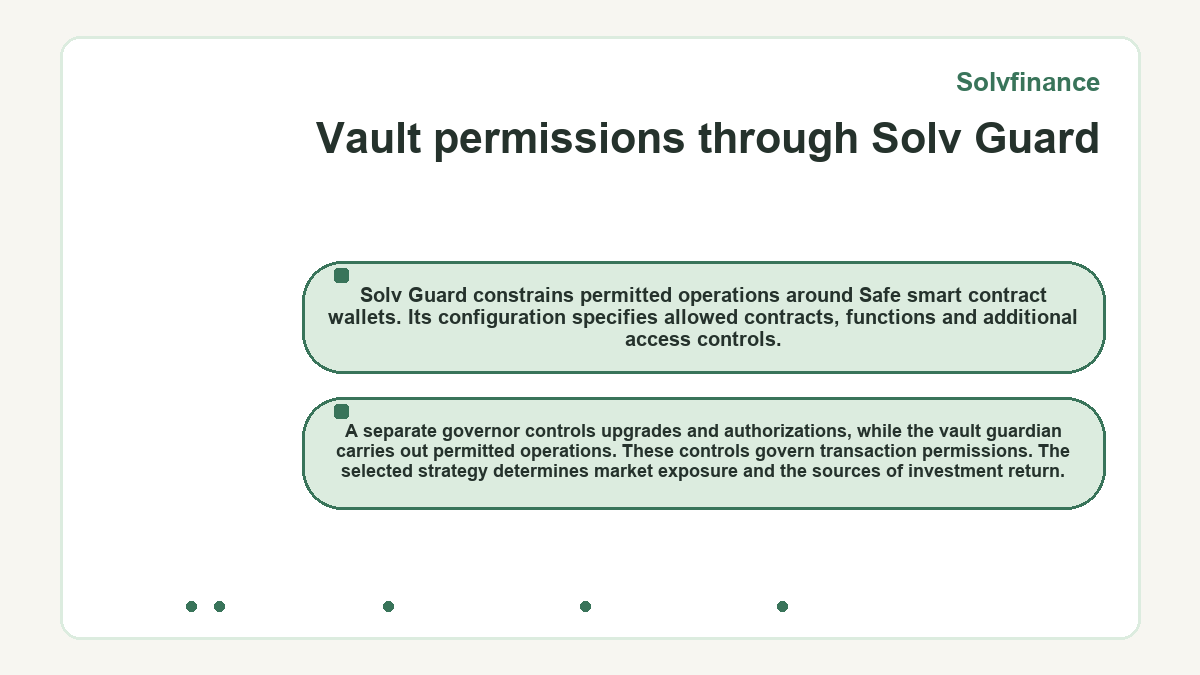
Solv Guard constrains permitted operations around Safe smart contract wallets. Its configuration specifies allowed contracts, functions and additional access controls. A separate governor controls upgrades and authorizations, while the vault guardian carries out permitted operations. These controls govern transaction permissions. The selected strategy determines market exposure and the sources of investment return.
Matching a Bitcoin requirement to the product terms
When the next task requires native BTC, a BTC+ share is an intermediate holding. Its NAV determines the value of the share, while redemption terms determine the asset and processing window available on exit. SolvBTC backing alone cannot answer those portfolio and withdrawal questions.
- For collateral or settlement, identify whether the destination application accepts SolvBTC on the chosen network.
- For Babylon-linked staking exposure, distinguish xSolvBTC rewards from any additional lending or liquidity-pool position.
- For BTC+ allocation, assess the sub-vault mix and its BTC-denominated investment objective.
- For a native BTC requirement, identify the actual redemption output and processing terms before entering a yield product.
- For cross-chain deployment, match the token contract, supported route and destination network.
Directly holding native BTC preserves a Bitcoin position outside Solv's reserve-token and vault structures. SolvBTC supports tokenized Bitcoin use, while xSolvBTC and BTC+ add staking-linked or managed allocation exposure with their respective redemption terms.
Solvfinance: what people ask
Are Solvfinance fees identical across its Bitcoin products?
Fees vary by product, asset and route. BTC+ lists a zero standard redemption fee and a 0.25% fee on the redeemed amount for its BNB Chain instant route. Deposit fees vary with the wrapped asset and network. Blockchain transaction costs remain separate from those product charges.
How do vault rewards appear when the receipt balance stays unchanged?
Some Solv Vaults incorporate yield into net asset value instead of distributing additional receipt tokens. The yield converts into SolvBTC and increases the value attributable to the vault shares, with gains realized through redemption. A stable receipt-token count can therefore coexist with a changing position value.
Can every wallet access Solvfinance regardless of location?
Solv's Terms of Use dated July 5, 2024 restrict interface access by jurisdiction and sanctions status. They also allow mandatory identity verification. Connecting a compatible wallet does not establish eligibility to use the interface, and institutional-only Bitcoin Reserve Offerings have a separate participation restriction.
Where do partner token rewards from Solv Vaults arrive?
Partner reward distributions can arrive directly in a wallet or require a claim through the partner protocol. For the claim-based route, distribution can follow the partner's token generation event. These external rewards differ from yield incorporated into a vault's net asset value and do not share one universal delivery process.
Does connecting a wallet require sharing its private key?
Connecting to Solv's interface does not require disclosing a wallet's private key. The interface does not store or request private keys or similar access credentials. Keeping those credentials secret remains necessary because anyone holding them may be able to transfer the wallet's assets.