 Solvfinance
 redemption routes and receiving assets
Solvfinance redemption of xSolvBTC converts the yield-bearing token into SolvBTC, so the immediate proceeds remain tokenized Bitcoin. Reaching an underlying reserve asset requires a separate SolvBTC redemption under that route's terms. Solv Protocol also offers BTC+ and individual vaults, whose receipt tokens follow their own exit rules. The relevant choice starts with the token you hold and the asset you want to receive. Instant xSolvBTC conversion does not establish instant delivery to a Bitcoin address.
An xSolvBTC withdrawal returns SolvBTC
The xSolvBTC withdrawal mechanism burns xSolvBTC and mints SolvBTC. The pool handles both changes within one withdrawal call and credits its caller with the net SolvBTC return.
SolvBTC can serve as a reserve asset within supported on-chain applications. Holding it after conversion therefore leaves a usable tokenized Bitcoin position, subject to each application's requirements. Native BTC delivery belongs to an exit route supporting that receiving asset. The word redemption covers both operations in product descriptions, although their receiving assets differ.
When does a SolvBTC redemption become claimable?
A standard SolvBTC redemption becomes claimable after the system allocates the corresponding reserve assets to the redemption contract. This structure serves users who minted SolvBTC against reserve assets. An onward withdrawal of converted holdings also needs to satisfy the selected route's eligibility terms.
The request credential
The standard route burns the submitted SolvBTC and creates a Redemption SFT, meaning semi-fungible token. This credential represents the request's processing state and claim eligibility. A reduced SolvBTC balance can therefore accompany an unfinished withdrawal: the request exists before the reserve assets arrive for collection.
Allocation before collection
The Safe Vault supplies the corresponding reserve assets to the redemption contract during the applicable processing period. Funding makes those assets available for the claim. The request credential and the allocated assets perform different jobs, so an SFT balance alone does not establish receipt of the underlying assets.
The payout follows the reserve asset corresponding to that redemption route. Reserve backing can include native BTC and wrapped Bitcoin representations. Their presence in the reserve does not make every representation an interchangeable payout choice. The selected redemption terms determine which asset the claim can deliver.
The token deployment and available balance come first
A redemption pool must accept the exact token deployment on the active network. xSolvBTC exists across multiple blockchains, including Ethereum and BNB Chain, with network-specific infrastructure. A matching ticker does not establish compatibility with a particular pool. The caller also needs the actual xSolvBTC input: a receipt representing a position in another DeFi application does not automatically substitute for it. These distinctions matter before authorizing an operation, because a balance displayed across an entire portfolio can include assets outside the balance the redemption contract can burn.
How long does an xSolvBTC redemption take?
The instant xSolvBTC route converts to SolvBTC on-chain without a scheduled withdrawal waiting period. It does not assign a delivery deadline to a subsequent reserve-asset claim.
An on-chain operation still needs successful execution on its network. Signing a wallet request or obtaining a transaction identifier does not establish the receiving balance. That execution establishes the xSolvBTC-to-SolvBTC conversion; reserve-asset withdrawals follow their own processing calendars.
The stages from xSolvBTC to a reserve-asset claim
For an exit continuing beyond SolvBTC, the request spans an xSolvBTC conversion and the standard reserve-asset route. The input must match the conversion pool, and the holder must qualify for a withdrawal supporting the intended reserve asset. The pool performs the conversion's burn and mint within the same withdrawal call.
| Stage | Asset or request change | Processing state or result |
|---|---|---|
| Request xSolvBTC conversion | The holder submits the xSolvBTC withdrawal | The selected pool accepts the input |
| Burn xSolvBTC | The pool burns the redeemed xSolvBTC | The conversion executes successfully |
| Receive SolvBTC | The pool mints the net SolvBTC return | SolvBTC reaches the caller |
| Request reserve assets | The standard route burns SolvBTC and issues a Redemption SFT | The withdrawal awaits allocation |
| Fund the redemption | The Safe Vault allocates corresponding reserve assets | The request reaches claim eligibility |
| Claim allocated assets | The holder claims the corresponding reserve assets | The receiving balance contains those assets |
For a native BTC exit, the final receiving asset must be BTC on Bitcoin; stopping at SolvBTC leaves the position tokenized.
Share value determines the gross conversion amount
The XSolvBTCPool withdrawal implementation converts the redeemed xSolvBTC shares into their SolvBTC value before calculating the withdrawal fee. Its token interface exposes this relationship through
getValueByShares
. The net return follows that share value and the applicable fee setting, so an identical count of input and output tokens is not a universal payout rule.
A 1:1 reserve-backing target describes backing, while a yield-token share can represent a different quantity of the underlying value. Keep the xSolvBTC quantity, its SolvBTC value and the net amount received in their respective units. A quoted percentage return or Bitcoin price does not replace the pool's conversion calculation.
The weekly SolvBTC processing calendar
The weekly SolvBTC redemption route processes Sunday-to-Saturday requests on the next Monday unless Monday is a holiday. A Monday holiday shifts processing to the following business day. This calendar concerns that SolvBTC reserve-asset route. The processing date does not replace the allocation and claim requirements or establish the time a receiving wallet will show its final asset.
Withdrawal charges and network gas use separate bases
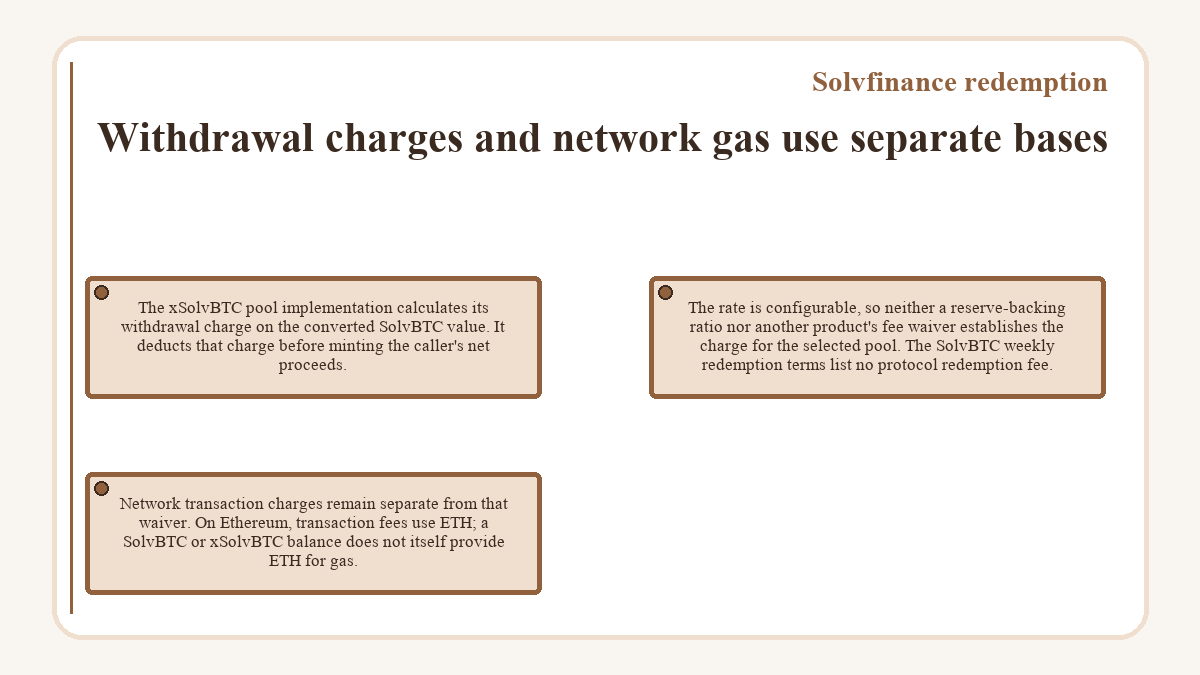
The xSolvBTC pool implementation calculates its withdrawal charge on the converted SolvBTC value. It deducts that charge before minting the caller's net proceeds. The rate is configurable, so neither a reserve-backing ratio nor another product's fee waiver establishes the charge for the selected pool.
The SolvBTC weekly redemption terms list no protocol redemption fee. Network transaction charges remain separate from that waiver. On Ethereum, transaction fees use ETH; a SolvBTC or xSolvBTC balance does not itself provide ETH for gas.
Liquidity buffers and reserve rebalancing support different functions
The instant-conversion architecture uses on-chain redemption contracts and liquidity buffers to support access to SolvBTC. Reserve rebalancing addresses the underlying BTC allocation between the SolvBTC vault and staking addresses. The mechanism monitors net xSolvBTC issuance and BTC already allocated to staking. When the allocation falls below the requirement, BTC moves toward staking; when it exceeds the requirement, BTC moves back toward the vault. This reserve-management activity supports the token system without turning each xSolvBTC conversion into an individual request for a Bitcoin transfer.
BTC+ and individual vaults have their own exit terms
BTC+ receipt value and processing windows
BTC+ redemption values the receipt at its current net asset value, including compounded yield minus applicable fees. Standard EVM requests submitted on days 1-9 process on the 20th; days 10-19 process at month-end; days 20 through month-end process on the following month's 10th. Request windows close at 23:59 UTC on their final day. Weekend processing dates move to the next business day. Non-EVM standard processing is listed as within seven days below 1 BTC+ and within 14 days above 1 BTC+. The published bands overlap at exactly 1 BTC+, leaving that amount's timing unclear.
BTC+ also has an instant method on BNB Chain that returns SolvBTC and deducts a 0.25% fee from the redeemed amount. Standard BTC+ redemption has no redemption fee. During an ongoing BTC+ APY Boost campaign, either method forfeits all accumulated Reward Power and eligibility for that campaign's boost. Published daily and per-transaction cap figures conflict, so confirm the applicable limits before submitting. If daily capacity runs out while an instant transaction is pending, the transaction reverts.
Individual vault schedules and receiving assets
Solv Vaults burn their own receipt tokens and return BTC or SolvBTC under the chosen vault's terms. SolvBTC.CORE processes at the beginning of each month. SolvBTC.BNB uses the 10th, 20th and month-end, while SolvBTC.DLP uses the 5th, 15th and 25th. Weekend dates move to the next business day.
Protocol conversion and a market sale produce different quotes
A secondary-market sale exchanges tokens against market liquidity, while protocol conversion follows the redemption mechanism. Where a compatible trading route exists, its liquidity, swap charge and execution conditions affect the receiving amount. Price impact describes how the trade itself moves the execution price. Slippage describes price changes between the quote and execution; the permitted tolerance constrains the acceptable change.
Compare a market quote and a pool return using the same receiving asset and network. A quote denominated in another token answers a different exit question. If the intended endpoint is a SolvBTC balance, the next choice is between the pool's net return and any available market quote for that same asset. A desired native BTC balance adds the reserve-asset withdrawal requirement.
Popular questions about Solvfinance redemption
-
Is an ERC-20 approval enough to complete an xSolvBTC redemption?
- An ERC-20 approval authorizes a spender and does not itself complete redemption. The allowance defines how much that spender may move from the account. Where an interface requests approval, the subsequent redemption still needs successful execution. An allowance belongs to the token contract where the account granted it.
-
Can a Redemption SFT be sent to a different wallet?
- The standard SolvBTC route does not use the Redemption SFT as a transferable asset. It carries processing status and claim eligibility for a withdrawal. That role does not provide a general mechanism for assigning the pending request to another wallet or selling it as a Bitcoin token.
-
How late can a BTC+ standard redemption request be cancelled?
- BTC+ standard redemption permits cancellation before the scheduled processing date. This permission concerns a pending standard request; it does not establish a cancellation right for an executed instant redemption. The relevant deadline follows that request's processing calendar.
-
Does redeeming xSolvBTC also release BABY rewards?
- The 2025 BABY program specified payment to a linked BABY address, separate from an xSolvBTC redemption's SolvBTC proceeds. That program required address registration and closed linking after June 9, 2025. Converting xSolvBTC does not create a new registration for that historical distribution or establish receipt of a BABY payment.
-
What distinguishes a cross-chain xSolvBTC transfer from a redemption?
- A cross-chain xSolvBTC transfer moves the token between networks, whereas redemption converts xSolvBTC into SolvBTC. Some supported cross-chain routes also use burning and minting, so a burn alone does not identify the operation. The destination network and receiving token distinguish a transferred xSolvBTC balance from SolvBTC redemption proceeds.