 Solvfinance
 reserves back SolvBTC with native BTC and wrapped Bitcoin assets
Solvfinance reserves support SolvBTC's 1:1 backing target with native BTC and supported wrapped Bitcoin assets. Solv Protocol groups backing assets within reserve models and uses different controls for custody, issuance and movement. Native Bitcoin requires Bitcoin transaction signing, while wrapped assets add the arrangements supporting their own Bitcoin claims. A reserve total therefore needs both an asset breakdown and a clear link to the tokens it backs. Proof of reserves addresses that backing relationship. Custody controls address who can move the assets, and redemption terms govern their return. A reserve total alone does not establish immediate access to native BTC.
Native BTC and wrapped Bitcoin can support the same reserve target while depending on different controls over asset movement.
Native BTC and wrapped assets create different custody dependencies
Native BTC reserves require control over Bitcoin addresses; wrapped reserve assets also depend on the system backing each token's Bitcoin claim. BTCB and cbBTC represent Bitcoin through token arrangements outside Bitcoin's native ledger. Their presence can contribute Bitcoin exposure to a reserve while adding dependencies on those representations. The relevant distinction is the asset the reserve actually holds and the system controlling access to its underlying Bitcoin.
A wrapped token and the Bitcoin supporting it represent the same economic exposure. Adding both as separate reserve assets would double-count that backing.
The 1:1 target measures backing against token supply
The backing target compares Bitcoin-denominated reserve assets with issued SolvBTC, so both sides need a matching accounting scope. SolvBTC targets one BTC-equivalent unit of reserve backing for each token in circulation. A dollar-denominated reserve total also changes with Bitcoin's dollar price, while a market quote for SolvBTC reflects conditions at its trading venue, so neither figure alone measures the Bitcoin quantity backing the reserve token.
Backing and immediate liquidity also differ. Assets can support a token while access to them still requires signing authorization and the applicable redemption process.
Reserve categories assign collateral and constrain issuance
Core reserve categories identify foundational backing assets, while isolated reserves assign segregated collateral to particular SolvBTC mints. The SolvBTC Introduction lists native BTC, BTCB and cbBTC as core reserves. The separate Reserves document lists native BTC and BTCB as core and cbBTC as innovative, leaving its applicable category unclear. The asset remains native BTC or a wrapped Bitcoin representation, with the custody arrangements applicable to that asset. Allocation and custody therefore describe different properties of the same backing.
The innovative-reserve model adds risk parameters around accepted wrapped assets. It applies minting caps and cross-chain rate limits. These controls address issuance and movement across chains. Minting caps describe permitted issuance, while an asset balance describes existing backing. A cap on minting against a reserve asset does not establish that the protocol actually holds that amount of Bitcoin. Category labels need the meaning the applicable reserve model gives them; they cannot identify current asset quantities on their own.
FROST custody separates signing authority and storage roles
FROST spreads Bitcoin signing authority across independent nodes, each holding a signing share. A sufficient subset must collaborate to authorize a transaction, so no single node can sign alone. The design also supports active vault addresses and cold storage addresses under a consistent signing model. That relationship explains control over native Bitcoin; it does not remove the separate custody assumptions attached to wrapped reserve assets.
Solv Protocol's Migration Roadmap targets full FROST infrastructure by the end of 2026. Its intermediate phase routes new deposits to FROST while retaining legacy storage. Under that phase, user redemptions draw first on hot wallet liquidity, followed by legacy cold reserves. The roadmap's completion target is not confirmation that every reserve address has migrated.
| Custody parameter | Condition governing reserve access |
|---|---|
| Signing authorization | A sufficient subset of FROST nodes must cooperate to sign a Bitcoin transaction. |
| Vault and cold storage addresses | The FROST design supports separate address roles under one signing model. |
| Transition liquidity order | The roadmap's transition phase prioritizes hot wallet liquidity, then legacy cold reserves, for user redemptions. |
| Address control and reserve quantity describe different parts of Bitcoin backing. | |
For a displayed balance assigned to a FROST-managed address, match the address's custody role to these conditions before relying on access to the BTC. A matching balance and control arrangement establish where that portion sits within the reserve system. They do not demonstrate current signer availability.
An address without an established reserve role leaves that conclusion unresolved. A migration target cannot supply the missing address classification.
Reserve reporting and vault permissions address different risks
Chainlink Proof of Reserve connects reserve information with on-chain reporting. It supports visibility into backing, while a custodian attestation concerns the assets a custodian reports holding. These records can cover different assets and reporting times. Neither a published address balance nor an attestation automatically describes every other pool or product. The relevant relationship is between a stated reserve scope and the outstanding tokens it supports.
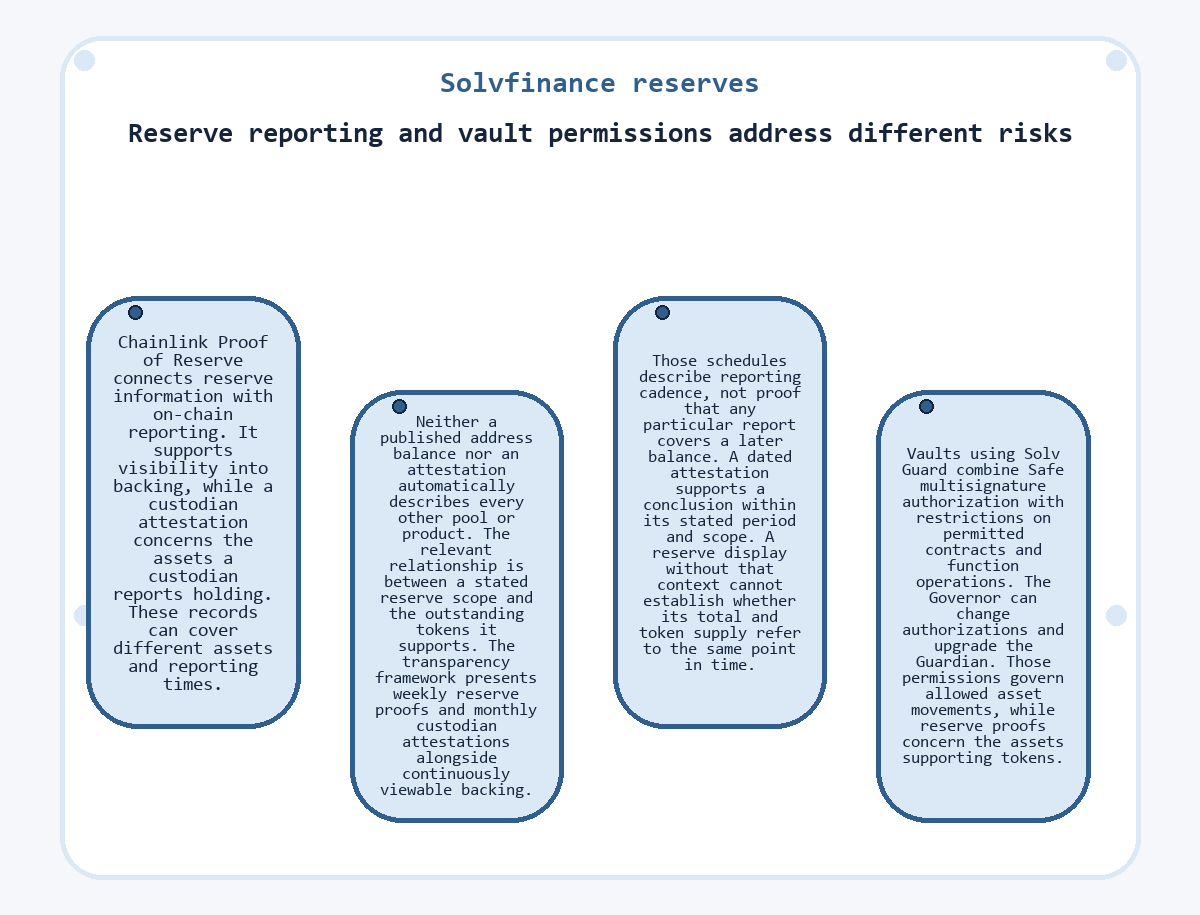
The transparency framework presents weekly reserve proofs and monthly custodian attestations alongside continuously viewable backing. Those schedules describe reporting cadence, not proof that any particular report covers a later balance. A dated attestation supports a conclusion within its stated period and scope. A reserve display without that context cannot establish whether its total and token supply refer to the same point in time.
Vaults using Solv Guard combine Safe multisignature authorization with restrictions on permitted contracts and function operations. The Governor can change authorizations and upgrade the Guardian. Those permissions govern allowed asset movements, while reserve proofs concern the assets supporting tokens.
Yield tokens and redemption claims require separate reserve interpretation
SolvBTC's reserve coverage and a yield product's performance answer different questions. The Staking Abstraction Layer separates reserve security from yield execution, while xSolvBTC adds a Babylon staking relationship. A fully backed token position can still have liquidity constraints imposed by its product terms. Reserve accounting therefore needs to retain the identity of the asset a position actually holds.
A redemption outcome must identify the asset a holder receives. Returning to a reserve token does not establish native Bitcoin delivery to a Bitcoin address. The remaining custody question concerns the assets backing that returned token and the route governing a further withdrawal. In the documented xSolvBTC conversion, the holder receives SolvBTC.
Solvfinance reserves FAQs
Does SOLV market capitalization count as Bitcoin reserve backing?
SOLV market capitalization does not measure the Bitcoin assets backing SolvBTC. It values a different token, while reserve coverage concerns collateral supporting issued SolvBTC. A rising SOLV valuation therefore cannot establish an increase in Bitcoin reserves.
Are reserve minting caps permanent?
The innovative-reserve model treats minting caps as adjustable parameters. Its design assigns initial parameter setting to Solv Protocol and proposes later decisions by token holders through decentralized governance. That proposal does not establish current token-holder control. A historical cap therefore cannot define the permitted issuance for every later mint or reserve asset.
Can a partner logo identify the custodian of a reserve asset?
A partner logo does not establish custody of a particular reserve balance. Custody requires a stated relationship between the reserve asset, controlling address and operator. Exchange, wallet and integration partners have different roles, so appearing beside a product does not by itself assign a partner control over its Bitcoin.
What does an unavailable reserve dashboard figure mean?
An unavailable reserve figure leaves the displayed quantity unknown; it does not establish zero backing. The display's date and asset scope matter before interpreting a missing number. An actual zero balance at one address has a narrower meaning: it describes that address, not automatically the entire SolvBTC reserve.
How does a SolvBTC burn affect the evidence of reserve delivery?
In the standard redemption path for users who minted SolvBTC with reserve assets, a burn begins the claim process without directly transferring reserves. A Redemption SFT, or semi-fungible token, records the request's state and claim eligibility. Asset allocation precedes claiming the corresponding reserves; the burn alone does not confirm delivery.