 Solvfinance
: using xSolvBTC in DeFi lending markets
Solvfinance provides xSolvBTC for compatible DeFi lending markets, where the Babylon-linked Bitcoin token can serve as collateral. The lending protocol determines borrowing capacity, interest and liquidation conditions around that token. Market support depends on the exact token deployment, network and pool.
The short version: Borrowing against xSolvBTC adds debt costs and liquidation conditions to a token position already exposed to Babylon staking.
xSolvBTC value and the borrowing limit
More eligible xSolvBTC increases collateral value at a given recognized price, although the market applies a collateral factor before allowing new debt. This factor specifies how much recognized collateral value contributes to borrowing capacity. Existing loans reduce remaining capacity, and available market liquidity can restrict the amount actually borrowable. Venus supports xSolvBTC as a lending-market asset, with collateral settings specific to the relevant pool and account mode. Its BNB Chain Core Pool is one documented application. The underlying token contract and network determine which balance a pool accepts. A listing in one deployment does not establish compatibility with another lending market.
Does supplying xSolvBTC automatically earn lending interest?
Supplying xSolvBTC does not establish a positive lending-interest rate. The applicable market rate determines interest on supplied assets. Babylon staking rewards and separately advertised incentives follow their own distribution rules, so borrowing access and interest income require separate treatment. xSolvBTC represents Bitcoin staked through the Babylon ecosystem. The lending protocol adds its own contracts and credit rules around the token.
Eligibility for Solv's 2025 BABY distribution included xSolvBTC deployed in listed DeFi protocols. Receiving tokens required linking a BABY address to an EVM address within the scheduled registration windows.
The stages of a Venus xSolvBTC position
A compatible xSolvBTC balance enters a Venus supply position before it can support an optional collateralized loan. An existing allowance may already cover supply. Network transaction fees also apply. The lending market then records supplied assets and any separate debt.
| Lending stage | Condition governing the position |
|---|---|
| Confirm the accepted xSolvBTC deployment | The pool must list the exact token contract on the chosen network. |
| Approve as needed and supply | The allowance must cover the underlying-token transfer; approval alone does not create a supply balance. |
| Enable eligible collateral and optionally borrow | Requested debt cannot exceed account borrowing power or the available liquidity of its market. |
| Monitor coverage on any debt | Ordinary liquidation depends on debt coverage under the account's effective liquidation settings. |
Some BNB Chain Core Pool token methods can return a nonzero protocol error without reverting the transaction. A mined transaction alone cannot establish successful supply or borrowing. The method result and corresponding market events must confirm the accepted operation.
Reward value and borrowing costs on a common basis
Cash-flow assessment requires reward value, any supply interest, debt interest and transaction costs over the same holding period. Each amount needs a common valuation unit before addition or subtraction. Asset-price changes remain separate from the financing cash flow.
Amounts and units in the position
Staking rewards and supply income
Reward tokens contribute their realizable value in the chosen unit, subject to eligibility and claim conditions. Any lending interest belongs to the supplied balance the market recognizes. Keep these components separate if a displayed annual percentage yield already includes an incentive, because adding it again double-counts income.
Interest on the borrowed balance
Borrowing interest applies to the outstanding borrowed amount over time. The initial xSolvBTC collateral balance is not the debt principal. Venus uses deployment-specific interest-rate models, so a displayed borrow rate can change with market conditions or configuration. Native network fees are separate from loan interest. Annualized rates also require matching calculation conventions. A snapshot annual percentage yield projects a rate using compounding assumptions; it does not establish income already earned. Display assumptions and changing rates can produce different outcomes over the actual holding period.
When can an xSolvBTC-backed loan face liquidation?
Ordinary liquidation becomes possible when recognized collateral no longer covers debt at the account's applicable liquidation threshold. Venus separates the collateral factor for new borrowing from the liquidation threshold for ordinary liquidation. The effective parameters can change with the account's selected E-Mode pool.
An oracle supplies the prices the market uses for collateral and debt. A fall in the recognized xSolvBTC price can reduce coverage, while accrued interest can increase outstanding debt. Reserve backing and market valuation therefore have distinct roles in the same position. If underlying Bitcoin suffers a Babylon slashing loss, the token's backing can decline as well.
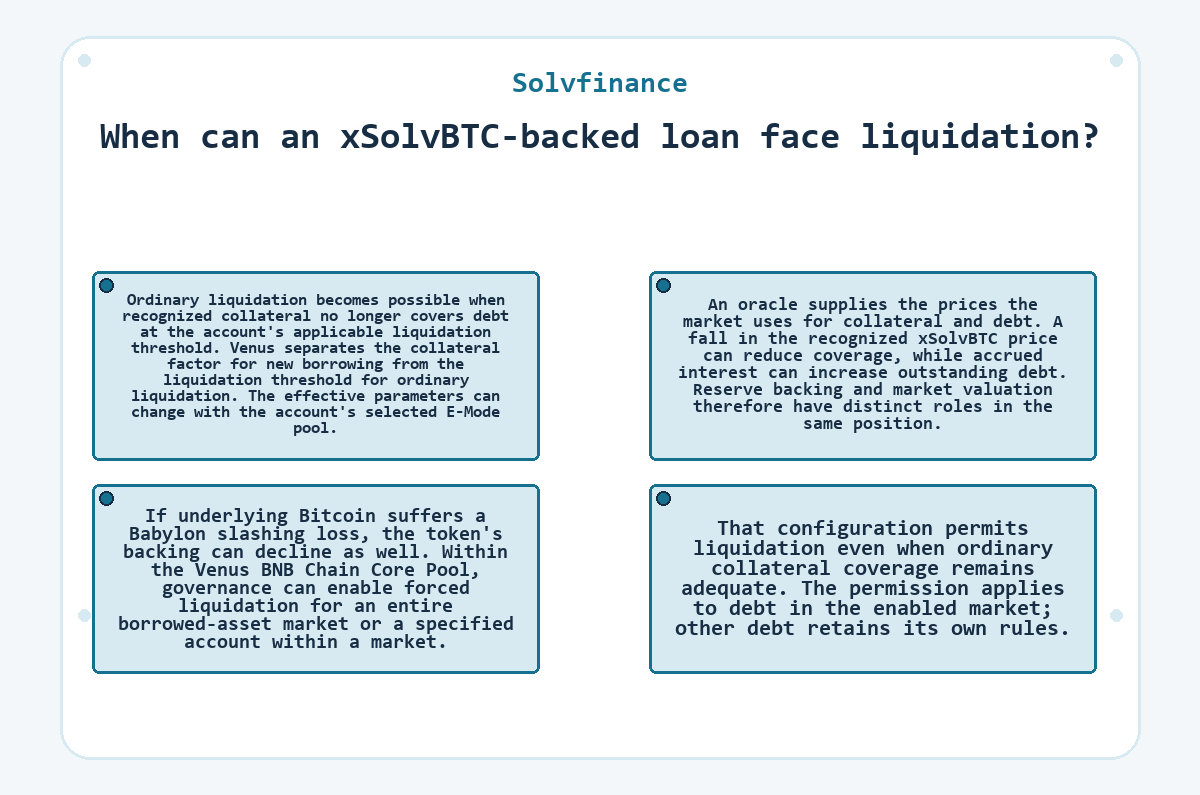
Within the Venus BNB Chain Core Pool, governance can enable forced liquidation for an entire borrowed-asset market or a specified account within a market. That configuration permits liquidation even when ordinary collateral coverage remains adequate. The permission applies to debt in the enabled market; other debt retains its own rules.
Collateral release and the return to SolvBTC
Debt in the same lending pool limits how much xSolvBTC collateral can leave a position. Withdrawal also depends on market liquidity and pause state. Partial repayment or additional eligible collateral can change the amount available for withdrawal. Repaying all debt in that pool removes its debt-coverage constraint, while other market restrictions can remain.
Solv's instant-redemption feature converts available xSolvBTC into SolvBTC on-chain. Its speed describes that conversion, not release of collateral from a lending protocol or delivery of native BTC. The lending contract controls withdrawal from the loan position; the Solv conversion controls the subsequent change from xSolvBTC to SolvBTC.
Solvfinance - common questions
Does approving a Venus receipt token authorize an xSolvBTC deposit?
Approving a Venus receipt token does not authorize transfer of the underlying xSolvBTC. The supply operation needs permission on xSolvBTC for the correct spending contract. A receipt-token approval instead permits transfers of that receipt token, creating a different authorization.
What does a Venus receipt-token balance represent after supplying xSolvBTC?
The receipt-token balance represents a claim on supplied xSolvBTC through the market's exchange rate. Its displayed token count need not equal the underlying xSolvBTC amount. Venus accounts for supply interest through the exchange rate, so an unchanged receipt-token count can correspond to a changing underlying balance.
Is xSolvBTC borrowing available wherever it qualifies as collateral?
Collateral eligibility and borrowing availability are separate market permissions. A protocol may accept supplied xSolvBTC as loan backing while preventing users from borrowing xSolvBTC itself. The collateral settings therefore do not establish which assets the market offers on the borrowing side.
Could a small xSolvBTC deposit exceed a Venus supply cap?
A small deposit can exceed the remaining space under a market's supply cap. Venus applies the cap to the market's aggregate supplied amount across wallets. Available capacity depends on existing supply and the active cap, so even a small deposit can fail when insufficient room remains.
Must existing debt qualify before moving an xSolvBTC position into Venus E-Mode?
Existing debt must meet the selected E-Mode pool's borrowing rules in the Venus BNB Chain Core Pool. Disallowed borrow positions require repayment before entry. Assets outside that pool follow Core Pool risk factors only if its fallback setting permits this; otherwise they must leave the collateral set.
Does the 2025 BABY distribution cover a new xSolvBTC lending deposit?
The 2025 BABY distribution schedule does not grant eligibility to a new xSolvBTC lending deposit. Its final scheduled batch required addresses linked before 00:00 UTC on June 9, 2025. Eligibility included qualifying xSolvBTC holdings and deployments in DeFi protocols listed for that distribution.
How does Bitcoin-linked debt affect xSolvBTC collateral risk?
Borrowing an asset tracking Bitcoin can reduce directional price mismatch with xSolvBTC collateral. It still leaves borrowing interest and differences between token valuations, together with staking and redemption risks. Correlated prices do not make the collateral and debt identical claims or eliminate liquidation exposure.